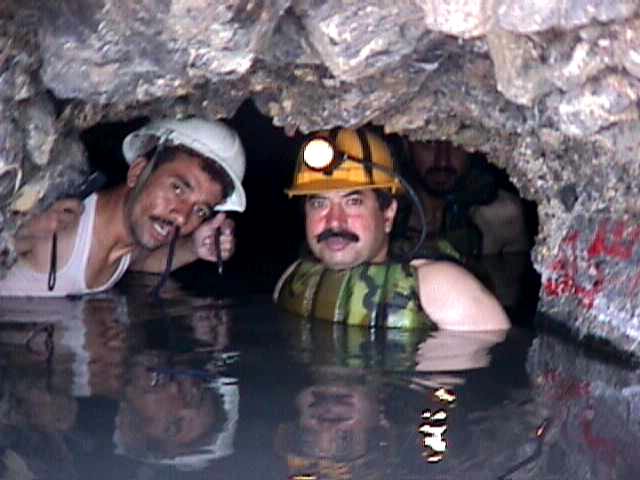
Members of the Chiltan Adventures Association (Baluchistan) in their new discovery: The cave is located in the Ghbarg Mountains Range and is Pakistan's first 'wet cave' with water between 2 and 4m deep.
Time moved on and in 1996 the hoped for dry bypass to Far Sump finally became a reality. There was increased caving traffic in this part of the system and we began to become concerned that people were using the original ropes, perhaps without realising that they were quite old and possibly not safe. In recent years various cavers have improved on some of the exploration bolting and have removed a lot of these original ropes. On one trip, about a year ago, Wayne Sheldon and Rick Hudson (TSG) came staggering out of JH with a couple of sacks of this recovered rope. It was in a dreadful condition - absolutely clarted up with filthy mud - and most of it was cut up and scrapped there and then. However one rope was noticed to have a heat shrink sleeve with a label beneath; this was washed and found to have the words: "OCC No 10, 41 metres, NYLON". The rope had a white sheath with a double line of black flecks running helically around the whole length of the sheath and is believed to be a 10 mm Edelrid rope. As the Orpheus takes good care of its ropes I contacted both Jenny Potts and Tim Holling to see if anything was known of its history. Tim told me (July 2002) that Rope 10 was placed into service in September 1984 and was last booked out in April 1988. There are no records of its usage but presumably it saw service fairly regularly through the successful Orpheus meets programme.
Before scrapping this rope I therefore removed a few metres from one end with a view to drop testing it. The idea behind this was that it might be interesting to see how much the rope had deteriorated during its 18 year working life, at least 13 years of which had been spent hanging down Balcombe's Way Aven in Peak Cavern. Rick Hudson kindly did the testing using the TSG's drop test rig. A standard 80 kg weight was used and the rope was first given a fall factor 1 drop to tighten the knots. It was then subjected to fall factor 2 drops until it failed. The rope survived the first FF 2 drop without any visible signs of damage. It then failed on the second FF 2 drop. I am far from expert on the meaning of these findings but having discussed them with people who know a lot more about this subject than I do, it suggests that Edelrid caving rope has excellent longevity when hanging in a cave. The consensus seems to be that a rope should survive two fall factor 2 drops if it is to remain in club use but many individuals said that they'd be happy to use a rope privately which only survived one FF 2 fall. It does seem to confirm a lot of cavers opinions that Edelrid make very good quality rope. Just how this rope found its way into Far Sump Extension remains a mystery.
It wasn't me who took it into Peak - honestly. The trouble is that in this area of the system once a rope comes out of a bag it immediately gets coated in mud so any identifying marks are obscured. If I'd have known at the time that an Orpheus club rope had gone in there I'd have gone to some effort to make sure it came out again soon afterwards. At least we've managed to salvage some useful information following the demise of what must be one of the longest serving ropes in the club!
John Cordingley
In another part of Baluchistan a cave in the Bolan Mountains Range has 21m of passage whilst a site in the Dadadora Mountains Range has yielded a cave with a large entrance and 65m of passage. Most significantly a cave located in the Ghbarg Mountains Range has become Pakistan's first 'wet cave' with water between 2 and 4m deep requiring swimming to explore its 52m length. [See cover photo.] Previous to this all caves explored in Pakistan have been dry. The Chiltan Adventures are currently exploring a cave known as Pane-e-Ghar in the Kalat/Johan Area where they have penetrated for around 150m with the cave still ongoing. The logistics of getting to this latter cave are interesting involving a two-day desert jeep drive and a day's camel ride just to get to the entrance. It should be noted that during the exploration of these caves the Chiltan Adventures Association have found no evidence whatsoever of the caves being used by any terrorist groups. Contrary to the media's belief that all caves are hideouts.
Alongside exploration the Chiltan Adventures Association and the Pakistan Cave Research Association have been promoting the science and sport of Speleology in Pakistan. A documentary (made during the 2000 expedition) entitled 'Caves In Balochistan' has been broadcast on PTV and PTV World TV Channels and a photo exhibition and seminar was held at the Serena Hotel in Quetta as part of the 2002 UN International year of Mountains. It is hoped that once events in the Middle East have settled down a small group of the Chiltan Adventures will be able to visit the UK during the summer of 2003 and at a later date a small group from the Orpheus Caving Club/GSG will be able to return to Pakistan and work alongside the Chiltan Adventurers in further cave exploration.
Simon Brooks
Because of the recent price increases there was a change in the beer arrangements. This year it was provided by Peter from the Royal Oak who came to the cottages during the week to put it into stillage in the extension - not only was it an excellent pint, it was an excellent price - many thanks to Pete he did us proud. The task of selling raffle tickets was delegated to Maz - wow does she have a talent for extracting money from the most "careful" of our members - many thanks to Maz you've got a job for life there. Thanks to every one who donated raffle prizes with special thanks to Sally who donated the excess leaving gifts she received when she moved to Buxton. This gave rise to a series of "special" prizes which resulted in some highly fragrant club members!
The meal was followed by a communal game of conkers, which after several pints went down very well. In true Orpheus spirit too much was eaten, too much was drunk, brussels were used as ammunition and some people (ie. Kenny this year) felt it necessary at some point during the celebrations to dance on the table - in other words a good time was had by all.
Sunday on the other hand was a much quieter day!
Tricia
| Best Underground Slide: | Boyd Potts, with a photo of Tim Holling in Damocles Rift. |
| Best Aboveground Slide: | Paul Lydon, with a photo in the Alps (Castor & Pollux?). |
| Best Underground Print: | Helen Watts & Derek Freeman with a photo taken from inside the Bournillon Cave entrance. |
| Best Aboveground Print: | Boo & Mick Chambers with a photo of the entrance to Owl Hole. |
Simon Brooks then entertained us for the rest of the evening with photos of the China Caves Expedition.
In discussion about a Club holiday abroad, it was suggested and agreed that a trip to Thailand would be a good idea. We have an ex OCC member working there, Dean Smart, who can help with advice and arrange things locally for those who want to go caving in a new area with prospects of making discoveries. It was also a good place for those who wanted to just "holiday" as there are good beaches and resorts. It was suggested we aim for October 2004 as being the best time of year to go weatherwise and far enough ahead to do some planning. Jenny said that she is now sending clubs/youth groups due to visit the Cottage a location map showing OCC's own "private" access to the Tissington Trail via the stile. (The map is also on the notice board.) Agreed this was a good idea but some people said it was now becoming fairly obvious from the Trail where the stile was so, if it became a problem, we would have to put a small "private Land" sign but we'd rather just keep it quiet. It was agreed we are having a problem again with well-meaning people bringing out furniture and cooking gear which is actually unsuitable and then has to be disposed of. A skip was organised for the week following the AGM - much of what goes in it will be this unwanted furniture, which we can't keep because it's not fire-resistant! PLEASE, don't bring out any armchairs, settees or cooking pots without first checking that they are wanted - ask Boyd or Dick Marley FIRST.
It was also noted at the AGM that others had completed work on the Cottage earlier in the year: the fireplace in the Common Room now has a metal plate as a hearth and just awaits finishing off; the Dining Room floor has been painted; all electrics are now finished and we have two working hot showers (thanks to Dick). Another picnic bench had been acquired and Coke did the necessary repairs to this so, when there is any, you can lounge outside in the sun!
Thanks are due to all the members who worked hard over the AGM weekend to tidy up the place: the junk from behind the tackle store was moved so that the septic tank manhole is clear again and much of it was disposed of via the skip, while the rest was stacked neatly; Kenny painted the outhouse roof and many others swept, cleaned and generally fettled things - thanks to all involved.
Following the AGM a skip was organised and, during the week, Boyd and Pete Wag. removed and burned all the over-large items of furniture so that the metal bits could go into the skip - which cost the club £120 to hire! We have now acquired, thanks to Jenni Brooks, a set of armchairs which are covered in fire-retardant fabric and which don't take up too much room. These have been installed in the Common Room to give us maximum seating capacity. A number of unwanted cooking pots, decrepit saucepans, etc. also went in the skip together with all the bonfire pile, including bedsprings, etc. from burnt mattresses.
"Calamine used to be mined at Croom Hill and Parkhouse Hill. It is said that the vein was 60 yards long, 3 feet wide and 6 feet high. Calamine is Zinc Carbonate (Smithsonite). It was roasted, using coal, to drive off the CO2, turning the ore into Zinc Oxide. It was mostly sent to Froghall and mixed with copper to make brass. It was also transported to the Milldale Smelting Mill at Alstonefield in Wiskers, which were special baskets used for carrying the ore."
I have contacted REAP and they tell me that the reference came from someone who lives in the Longnor/Hollinsclough Area. I am certainly not aware of a mine of this size on Chrome Hill, although on the Hollinsclough side there is a short rift that could well be the now run-in entrance to a mine. Does anyone have any information about this site as 60m of passage in the Upper Dove Area would be well worth finding.
Simon Brooks
Everyone travelled up in the morning and met at the car park in Buckden at the appointed time of 10:30. After a quick discussion in the rain on alternatives, we decided to have a brew in the tea house in Kettlewell and come up with some options. Deciding that it would be preferable to do something in the area rather than face a lengthy drive somewhere else, we decided on Dow Cave. Boyd declined to visit this system for the 1000th time and spent the day in other activities with an agreement to meet up later in Ingleton.
We drove to the layby near a bridge and changed, then walked to the cave entrance. We soon reached Hobson's Choice which has warnings regarding loose boulders and rocks, so with Pete in the lead, we followed very carefully through the boulder choke and were soon through without mishap. After climbing a 20 foot (or 7 metres, if you like) waterfall with a large, narrow flake of rock to assist progress, or alternatively some chimneyed up out of the water with assistance from a handline, we continued onwards. Passing some nice formations and also, unfortunately, evidence of past meal breaks with rusty old cans, plastic and dumped carbide we eventually reached another boulder choke.
Pete investigated a low route taking the stream while the rest followed Lesley and Mark up a climb through the boulders. When Lesley reached a part which was too small continue (i.e. no chance for the rest of us of larger proportions!), we retraced our steps to find Pete who also reached a very low, very wet section with not much hope of continuing.
We headed back towards the entrance, passing the climb down the waterfall and passing through Hobson's Choice without any problems. Bell and I waited outside for a while the rest had a look at the route through to Dowbergill Passage, leading to Providence Pot.
After getting changed we set off for Ingleton for another brew and chip butties at Bernie's then retired to the Marton Arms for more food.
T.U.G. 3 ¼ hrs.
Paul Lydon
We had planned to pay a visit to White Scar back in April but this was rained off. Now was a good time to try again. Arriving at the car park just after 10:00 am, we found two other groups of cavers getting changed. One group seemed to be locals and the other were from Hades C.C. Pete wag had a talk with the cave management and we agreed to visit the cave with the Hades group.
We made our way into the show cave just after 10:30 am passing tourists being fitted up with helmets, eyeing our get-up as we passed by and wondering what they had let themselves in for, and soon reach the stairs up to Battlefield Chamber. Its always a good idea to visit the Chamber as this gets you warmed up for the forthcoming delights of swimming in cold water!
After a quick look around Battlefield Chamber the inevitable immersion in the cold water soon followed, accompanied by shrieks from some of the other party in front. As soon as we all re-grouped at Big Bertha (a very large boulder, not a female member of the Hades!), Mark O'Keefe lead the way through via a gap low on the right. There is an orange line to assist in route finding and if this is more-or-less followed it is straight- forward. We were soon all through.
Some of us had a look up the side passage on the left on the way in after a short climb up a soft, white formation, then continued on down the streamway with occasional piles of rocks to climb over and deeper sections to wade through. Some traversed out of the water while others found it quicker and easier to wade and/or swim beneath.
After a low section which is easy to pass through as you float along in the water, we waited in a small chamber for Pete Wag and Brian to come through but they declined. I continued on through a duck low down on the right for a short distance, then decided to not go any further as I had already been to the sump on the last visit (well, that was my excuse...). Lesley joined me in returning back the way we came while Mark and Bell continued on to have a look at the sump.
Back at a junction we saw Pete and Brian in a side passage on the right (as you go out) up a short climb. This side passage was quite muddy and had a makeshift tent (made from a large thick bag held open by line) plus hexamine stove and kettle - obviously a resting place by somebody having a dig around. Climbing a section of horrible gooey mud, we followed Pete who found the going even muddier leading to a dig down a muddy tube (don't tell Ken about this!).
Returning to the streamway we continued towards the exit soon reaching the section of boulder choke which was passed without problems to reach the end of the show cave. We met some of the other party near the entrance who confessed to not having got past the Big Bertha boulder choke! After changing we retired to Bernie's for a bit of apres-cave tea.
T.U.G. 3 hrs.
Paul Lydon
Rigging from one of the large boulders at the entrance just before midday, we all abseiled down with just one rebelay a couple of metres down. Once past the restricted section at the surface, there was plenty of time to look around the magnificent shaft. Brian succeeded in descending the shaft without dropping his car keys as on the previous visit!
Once down, the way on was up on to a ledge following a high rift to the impressive Bridge Cavern. As Doug hadn't seen the Colonades before, Boyd took him up an easy climb up to the left, followed by a short traverse into Colonnades Passage, to have a look.
We continued along the main route with a short drop down on the right hand side and bottom of the boulder slope, leading into Kath's Way. This started as a crawl but soon became larger, arriving at a T-Junction, with both ways leading to Fall Pot. We turned left here to find a further T-Junction after a short distance. In front were some deep holes which apparently drop directly to the sump some 30 metres below.
To the left, above the deep holes, was a mud slope which we cautiously ascended using steps worn into the mud, leading to a mud choke. The choke was by-passed through a small phreatic tube about a metre and a half above the floor. Although there was a short iron ladder to assist getting into this tube, a crucial rung was missing and those of us with longer legs found it a bit of a struggle to get established in the tube. I passed around a fin of rock to see Doug's wellies sticking out with their owner thrashing about in the tube. After reversing and trying to get into the tube higher up, Doug was soon through. I tried to follow but found it caused some pain in my right knee which I had twisted a bit yesterday when walking up Ingleborough and tripped over a small hole. Rather than risking having to turn around later on if the knee became worse, I was going to retreat from here and exit by re-ascending the shaft at Lancaster Hole. Pete reminded me of the muddy slope and the deep holes waiting for anybody who slipped - I decided to continue! Anyway, with a shove from Brian on my other leg, I was soon through the tube.
This led into Montague West passage with easy going, mixed crawling and walking, eventually leading to a yet another T-Junction. The left led down to Waterfall Passage, which carries the water from Bull Pot of The Witches to the Master Cave. We, however, turned right at the junction, passing after a bit a hole in the floor, which also leads to Waterfall Passage.
Continuing along the passage, we soon passed another passage on the left, again leading to Waterfall Passage. Shortly after, a drop down at another T-Junction was reached, which was Wilf Taylor's passage, upstream leading to the sump connection with Bull Pot of Witches.
Following Wilf Taylor's Passage downstream there was a handline-equipped climb down to a pool with a nasty little overhang at the bottom, which made things awkward. Next was small hole, again rigged with handline, which looked more difficult than it was when viewed from above. Dropping down the steep initial metre or so led onto a sloping, narrow ledge with a final drop down to the floor, swinging around an arete.
We were soon in the Master Cave at the way down from Fall Pot. The passage became narrower with cascades and circular pools. Following a streamway like this always gives me the impression of the cave as having some sort of 'life' unlike the 'dead' nature of dry, dusty passages you find in many caves. Shortly after another pile of boulders was met: the Stake Pot run-in. If there is any doubt about the amount of water, you can retreat here up into the High Level route, by climbing up the boulders to the highest point to a short rope climb leading to the col at Stake Pot. The High Level Route can then be followed to the left to Stop Pot.
As we had good weather conditions, we continued following the streamway, with the walls disappearing upwards out of sight. After 400 metres or so, we met a boulder choke and followed the obvious route through this, keeping close to the stream: hence the need for dry conditions.
Climbing out of the streamway up another in situ handline, we emerged close to Oxbow corner. Following up a boulder slope brought us to the well-worn High Level Route. Going in the opposite direction, we next followed the now right-hand wall along the roof bedding above the climb up. Doug was following a slight depression on the muddy floor as we crawled along on the slippery surface and almost slid head first back onto the chamber floor!
After 40 metres or so we popped out into a chamber. The route through the next two chambers was not obvious, but the exit is opposite the point of entry in each chamber. The exit from the second chamber, which is Oake's Cavern was down an hidden step down and wasn't at all easy to see to start with. After Oake's Cavern, the passage led straight to the Minarets, which can be by-passed, as proved by Boyd, but is such a nice section of passage (plus there's a photo on the front of the guide book!), that it seemed a pity to miss it out. Next we arrived at Corne's Cavern, which was traversed near the roof on the left hand side although the sloping muddy floor made traversing the cavern a bit awkward for those of us still having water slopping out of their wellies. This was followed by Snail Cavern with a rope hanging down from a passage in the Mancunian Way series. It was then up and down a boulder slope to arrive at Monster Cavern, leading into a very wide Main Line Terminus.
Manchester Bypass was to the right, but we went straight on across the chamber towards Stop Pot with some very greasy boulders. Shortly afterwards was a short climb up to the left which led to a point where the roof of Stop Pot could be seen. Climbing down the fixed iron ladder, which is a bit awkward at the top, we followed down the boulder slope back to the stream at the bottom.
From here there are two ways of getting into the Wretched Rabbit passage and only one is passable if water levels are too high. There is a low crawl near the foot of the ladder which is the route followed on my last visit as water conditions were then high.
On this occasion, however, we followed the stream via a low passage and went onwards to Eureka Junction then turned left. The passage soon divided into two, with the left hand branch being Wretched Rabbit Passage (the right branch is Pierce's Passage). We took the left option into Wretched Rabbit (which is impassable in high water conditions). Following the passage with the stream, we crawled up through a slot under some boulders into a lower section.
Soon we reached a small chamber. To the left was a hole into Four Ways Chamber, the next objective, but you can't get there via the hole. To the right of the hole, however, you can climb up through a slot which leads to a shelf in the chamber, but it isn't obvious.
We next traversed into the chamber, and climbed down to where there were two holes leading down into the stream passage. The one to the right was less constricted, requiring a bridging move to gain entry. After a few metres, we were in the stream a few metres downstream of the crawl up through the slot mentioned previously.
Next we followed another crawl, starting in the stream then to the left, eventually reaching a cross-rift. Here, we turned right up over a boulder into a rift passage with a bit of traversing, shortly after that the stream was rejoined.
The way on next was straightforward with some nice cascades to climb, including a climb up just before a junction of two streams, with the Wretched Rabbit stream coming in from the right. Strangely enough, we had to climb into the passage on the left in order to reach the way on! Apparently there is a nasty route back to Stop Pot if you do go to the left - I'm surprised Pete didn't head off down that way just for the fun of it (if he had done - I bet not many would have followed)!
pSoon we reached the sting-in-the-tail after more easy going with high rift passages: four rope-assisted climbs up one after the other! The first was straightforward with plenty of footholds. One in the middle was three or four metres with just one reasonable foothold near the top. Another had a couple of loops tied in the handline and I found it easier to use these. Thankfully grabbing the scaffolding tube at the top of the final step, which is short but arrives too soon after the previous climb, we turned right into the short crawl popping out into the Easegill stream bed at 16:45.
We walked back in the dark, carefully trying not to slip on the very greasy rock in the stream bed. While some made a detour on the way back and retrieved the rope from Lancaster Hole, the remainder continued onwards to get changed next to the cars at Bull Pot Farm.
Next stop: Bernies for a brew and chip butties after another classic caving trip.
TUG 5 hours.
Paul Lydon
DCA's Conservation Officer, David Webb, sent a message to the 10 club cavers primarily responsible for the monitoring work, which was carried out during normal club caving trips: "I can't begin to tell you how thrilled I am that we have been given this recognition, and of course it would not have been possible without your help and hard work - it has been a true team effort. However it's not over yet and there's still work to do - but I think we can feel justifiably proud of what we have achieved so far." David will be presented with the award on DCA's behalf at the Royal Show on July 1st.
Among those who have worked on the project are Boyd and Pete Wag - congratulations to both.
Including a description of the Geological, Mineralogical and Archaeological Interest of the site and a Conservation Plan. Thirteen pages of colour photographs together with maps and surveys. Contains bibliography and glossary plus appendices. Includes a brief account of the accessible passages of both Wapping Mine and Cumberland Cavern with maps and surveys and a brief summary of the past history of the system and previous research undertaken here. The character of natural and archaeological features worthy of conservation is outlined and practical con-servation measures are discussed for this important Scheduled Site of Scientific Interest. Specification: 48 pages A4, 3 x A3 surveys; 44 illustrations.
Price £10.00 plus 90p postage if you buy it before the end of June, after that it's £11.00. Available from Jenny Potts, make cheques payable to DCA.
| June 7/8 | - Berger Reunion weekend at OCC Cottage |
| June 14/15 | - Mendip 2003 - Cavers Fair & SpeleoVideo |
| June 21/22 | - OCC Barbecue at the Cottage |
| July 12/13 | - South Wales: Draenen / Aggie |
| May 24-26 | - Hampshire Scouts Caving Club (10) |
| May 27 - 30 (Tuesday to Friday) | - OCC Families Week |
| June 7/8 | - Berger Reunion Bash - OCC, Wessex & DSS |
| June 21/22 | - OCC Barbecue at the Cottage |
| June 29 (Sun.) | - Duke of Edinburgh Award Group camping |
| July 1 (Tue.) | - Duke of Edinburgh Award Group camping |
| July 3 (Thur.) | - Duke of Edinburgh Award Group camping |
| July 18/19 | - Cerberus S. S. (8) |
| Aug. 2-10 | - Shepton members staying (2) |
| Sept. 7-14 | - Karen's group |
| Chairman: Boyd Potts, 3 Greenway, Hulland Ward, Ashbourne, Derbys. DE6 3FE. 01335-370629 e-mail via dca@theDCA.org.uk |
| Secretary: Pete Wagstaff, 43 Sandbed Lane, Belper, Derbyshire. DE56 0SJ. 01773-826920, e-mail. pete@orpheuscavingclub.co.uk |
| Treasurer: Tricia Webber, 38 Wheeldon Ave., Derby, DE22 1HN. 01332-362568, e-mail. Tricia@mcgregor-corporate.co.uk |
| Librarian: Simon Brooks, 11 Margery Close, Ashbourne, Derbyshire, DE6 1GZ. 01335-346411 e-mail. Simonj.Brooks@btopenworld.com |
| Hostel Warden: Dick Marley, 15 Elmwood Road, Streetley, Sutton Coldfield, B74 2DF. 0121-353-1504 e-mail. Richard.Marley@btinternet.com |
| Tackle Master: Tim Holling, 35 Burdock Close, Oakwood, Derby, DE21 2BX. 01332-830460 e-mail. caver@ntlworld.com |
| Caving Secretary: Boo Webster, Flat 56, The Firs, Ashbourne, Derbys. 01335-343606, E-mail. Boocaver@hotmail.com |
| Doug Hobbs, 40 Madison Ave., Chaddesden, Derby. DE21 6JA. Mob. 07960-781148, e-mail. doughobbs@ukonline.co.uk |
| Paul Lydon, Hefford House, Main St. Winster, Matlock. DE4 2DH Tel. 01629-650482, E-mail. paul@palydon.demon.co.uk |
| Hostel Booking Secretary: Jenny Potts, Greenway, Hulland Ward, Ashbourne,Derbyshire. DE6 3FE. 01335-370629 e-mail. dca@theDCA.org.uk |
| Dave Jones, Cedar House, Burton Rd., Streethay, Lichfield, Staffs. WS13 8LS. 01543-263082, e-mail. dj.cedar@clara.co.uk |
| Mick Hogg, 32 Birchley Heath, Nuneaton, Warwicks. 01827-713958 |
| Heather Lomas, Cedar House, Burton Rd., Streethay, Lichfield, Staffs. WS13 8LS. 01543-263082 e-mail. via dj.cedar@clara.co.uk |
| Boyd Potts, 3 Greenway, Hulland Ward, Ashbourne, Derbys. DE6 3FE. 01335-370629 |
| Boo Webster, Flat 56, The Firs, Ashbourne, Derbys. 01335-343606 |
| Pete Wagstaff, 43 Sandbed Lane, Belper, Derbyshire. DE56 0SJ. 01773-826920, e-mail. PWAGSTAFF@dsfderby.com |
Please send your news, views, etc. to Jenny by snail-mail or e-mail (If you send by e-mail we are happy to accept text files or Word files) - we will accept your article written on the back of a beer-mat if necessary - just get writing! You can send photos or we may be able to accept e-mailed pictures now if they are in certain formats as we now have "transmogrifying programs" which work on JPEG and TIF files but, of course, I can always read Acorn !Draw and !Paint files. If you want to try this, give Jenny a call first to warn of what's coming. Send your offerings to:
Jenny Potts, 3 Greenway, Hulland Ward, Ashbourne, Derbyshire. DE6 3FE. E-mail. dca@theDCA.org.uk
In the next issue: Tales from the Log Book - more discoveries from the Chiltans!
Editor's Bit: Apologies for the late appearance of this issue of the Newsletter - 10 weeks abroad, followed by a month of flu and recovering from flu, followed by the DCA AGM to organise, followed by the NCA AGM, has played havoc with what little organisation we possess. We'll try to make the next Newsletter a mega-issue to catch up with things and get back on schedule.